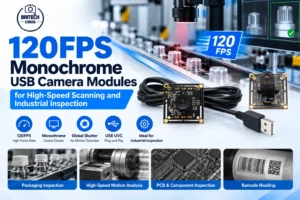

120FPS Monochrome USB Camera Modules for High-Speed Scanning and Industrial Inspection
A moving object can be perfectly visible to an operator and still be difficult for a vision algorithm to measure. On a conveyor, barcode edges shift between frames; in a rapid scanner, insufficient frame sampling can miss useful views; and in an inspection station, uneven lighting can obscure the contrast needed for reliable detection. For these systems, selecting the right monochrome camera involves more than choosing a megapixel count. A 120FPS monochrome USB camera module is worth evaluating when an OEM needs fast frame capture, contrast-focused imagery and a practical host connection. CBRITECH offers a 720P USB 2.0 global-shutter module based on the 1/3-inch OV0720 sensor, with monochrome and color options. The product is positioned for fast scanners, industrial inspection, high-speed animal capture and sports imaging. View the CBRITECH 120FPS global-shutter monochrome USB camera module When should an OEM choose monochrome instead of color? Color is essential when the application must distinguish labels, markings or components by hue. In other inspection tasks, the software only needs edges, silhouettes, texture, contrast or shape. A monochrome configuration avoids the need to preserve color information in the same way as a color image and can simplify a contrast-based image-processing pipeline. That does not guarantee better results: the lighting wavelength, target surface and actual camera output format still determine useful image quality. For a barcode reader or high-speed sorting prototype, define the smallest feature that must be detected and test its contrast under production lighting. Choose monochrome because the measurement needs it—not simply because the camera is marketed as industrial. What 120FPS means in a real inspection workflow Frame rate tells you how frequently a camera can deliver images, not whether each image will be sharp. CBRITECH specifies 1280 × 720 at 120FPS in MJPEG mode and 1280 × 720 at 90FPS in YUY2 mode. This difference matters: a host application requesting an uncompressed format should not assume the same maximum rate advertised for MJPEG. At 120 frames per second, the nominal interval between frames is about 8.3 milliseconds. Engineers should still calculate how far the target travels between captures and how far it moves during the exposure itself. Shorter exposure, adequate illumination and appropriate optics remain necessary for a usable frame. Actual sustained capture must be validated on the chosen host, driver and USB topology. Why the global shutter matters—and what it does not fix The product uses an electronic global shutter, which captures the active scene with a common exposure interval rather than sampling rows at different moments. This is useful where the shape or location of moving parts matters. However, global shutter does not eliminate motion blur caused by a long exposure or inadequate light. Those are separate design problems. CBRITECH already has a detailed explanation of shutter architectures. For a fundamental comparison, use that guide; the focus here is how to configure a particular high-speed monochrome USB module for a measurable task. Read: Global Shutter vs Rolling Shutter Camera Modules USB 2.0, MJPEG and YUY2: choose the output deliberately The OV0720 product lists high-speed USB 2.0 and UVC compliance. Its two stated 720P capture configurations—MJPEG at 120FPS and YUY2 at 90FPS—show why format selection is an integration decision. MJPEG can reduce transport demand but requires decoding and may introduce compression artifacts. YUY2 provides a different image-data path, with its own bandwidth and host-processing considerations. Test the exact pixel format your inspection software will consume, including dropped frames, CPU usage and latency. The listed module is powered at DC 5V and measures 38 × 38 mm. Before enclosure design, verify cable routing, mounting clearances, the available USB controller and the operating temperature range of 0°C to 60°C. CBRITECH lists Windows, Linux with UVC support and Android with UVC support among its host environments; the finished OEM system should still be qualified independently. Optics and lighting: the often-missed ranking of priorities The module lists a 93° diagonal and 63° horizontal field of view, fixed focus, an F/2.24 lens and a minimum illumination specification of 0.1 lux. These are useful starting points, but they do not determine whether a specific part will occupy enough pixels for accurate measurement. Engineers should calculate the working field width and minimum target-feature size, then test distortion and focus at the intended distance. CBRITECH also lists an IR filter specification and support for an 850 nm infrared-film lens option. When developing a monochrome inspection station, match the lighting wavelength to the target material and confirm the delivered optical configuration. A controlled light source can often improve edge consistency more than increasing nominal camera resolution. Four practical OEM application scenarios Fast scanning: Evaluate how many usable frames are captured while the code or document passes through the field of view. Confirm decode performance using the actual MJPEG or YUY2 output rather than assuming all frame-rate modes are equivalent. Conveyor inspection: Synchronize acquisition and illumination to the product movement. Validate geometric consistency, exposure and false-reject rates across production speeds. Motion analysis: A high frame rate offers denser sampling of movement, but lighting and exposure still control the clarity of each individual frame. Contrast-led measurement: Where color is unnecessary, test the monochrome option with the intended target, optics and software thresholds before committing to an OEM configuration. A sensible evaluation checklist before requesting a quote Share the intended application, target speed, smallest feature size, working distance, lighting conditions, required pixel format, expected frame rate, host operating system, mounting constraints and projected order volume. Ask the supplier to confirm the monochrome variant, lens and filter arrangement, cable length, software compatibility and sample availability. These inputs make a product inquiry actionable rather than a generic request for a “120FPS camera.” Check the product specifications and request an OEM quotation Frequently asked questions Is the CBRITECH module truly 120FPS at 720P? The published specification lists 1280 × 720 at 120FPS for MJPEG and 1280 × 720 at 90FPS for YUY2. Validate the required output mode on your own host. Does global shutter eliminate blur? It reduces row-to-row motion distortion, but a moving object