Category: Monochrome Cameras

120FPS Monochrome Industrial Inspection Camera
Monochrome Cameras
Opti Bridge Solutions

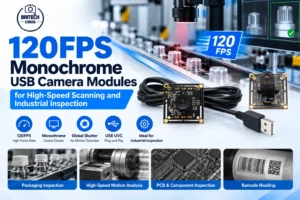
120FPS Monochrome USB Camera Modules for High-Speed Scanning and Industrial Inspection

A moving object can be perfectly visible to an operator and still be difficult for a vision algorithm to measure. On a conveyor, barcode edges shift between frames; in a rapid scanner, insufficient frame sampling can miss useful views; and in an inspection station, uneven lighting can obscure the contrast needed for reliable detection. For these systems, selecting the right monochrome camera involves more than choosing a megapixel count. A 120FPS monochrome USB camera module is worth evaluating when an OEM needs fast frame capture, contrast-focused imagery and a practical host connection. CBRITECH offers a 720P USB 2.0 global-shutter module based on the 1/3-inch OV0720 sensor, with monochrome and color options. The product is positioned for fast scanners, industrial inspection, high-speed animal capture and sports imaging. View the CBRITECH 120FPS global-shutter monochrome USB camera module When should an OEM choose monochrome instead of color? Color is essential when the application must distinguish labels, markings or components by hue. In other inspection tasks, the software only needs edges, silhouettes, texture, contrast or shape. A monochrome configuration avoids the need to preserve color information in the same way as a color image and can simplify a contrast-based image-processing pipeline. That does not guarantee better results: the lighting wavelength, target surface and actual camera output format still determine useful image quality. For a barcode reader or high-speed sorting prototype, define the smallest feature that must be detected and test its contrast under production lighting. Choose monochrome because the measurement needs it—not simply because the camera is marketed as industrial. What 120FPS means in a real inspection workflow Frame rate tells you how frequently a camera can deliver images, not whether each image will be sharp. CBRITECH specifies 1280 × 720 at 120FPS in MJPEG mode and 1280 × 720 at 90FPS in YUY2 mode. This difference matters: a host application requesting an uncompressed format should not assume the same maximum rate advertised for MJPEG. At 120 frames per second, the nominal interval between frames is about 8.3 milliseconds. Engineers should still calculate how far the target travels between captures and how far it moves during the exposure itself. Shorter exposure, adequate illumination and appropriate optics remain necessary for a usable frame. Actual sustained capture must be validated on the chosen host, driver and USB topology. Why the global shutter matters—and what it does not fix The product uses an electronic global shutter, which captures the active scene with a common exposure interval rather than sampling rows at different moments. This is useful where the shape or location of moving parts matters. However, global shutter does not eliminate motion blur caused by a long exposure or inadequate light. Those are separate design problems. CBRITECH already has a detailed explanation of shutter architectures. For a fundamental comparison, use that guide; the focus here is how to configure a particular high-speed monochrome USB module for a measurable task. Read: Global Shutter vs Rolling Shutter Camera Modules USB 2.0, MJPEG and YUY2: choose the output deliberately The OV0720 product lists high-speed USB 2.0 and UVC compliance. Its two stated 720P capture configurations—MJPEG at 120FPS and YUY2 at 90FPS—show why format selection is an integration decision. MJPEG can reduce transport demand but requires decoding and may introduce compression artifacts. YUY2 provides a different image-data path, with its own bandwidth and host-processing considerations. Test the exact pixel format your inspection software will consume, including dropped frames, CPU usage and latency. The listed module is powered at DC 5V and measures 38 × 38 mm. Before enclosure design, verify cable routing, mounting clearances, the available USB controller and the operating temperature range of 0°C to 60°C. CBRITECH lists Windows, Linux with UVC support and Android with UVC support among its host environments; the finished OEM system should still be qualified independently. Optics and lighting: the often-missed ranking of priorities The module lists a 93° diagonal and 63° horizontal field of view, fixed focus, an F/2.24 lens and a minimum illumination specification of 0.1 lux. These are useful starting points, but they do not determine whether a specific part will occupy enough pixels for accurate measurement. Engineers should calculate the working field width and minimum target-feature size, then test distortion and focus at the intended distance. CBRITECH also lists an IR filter specification and support for an 850 nm infrared-film lens option. When developing a monochrome inspection station, match the lighting wavelength to the target material and confirm the delivered optical configuration. A controlled light source can often improve edge consistency more than increasing nominal camera resolution. Four practical OEM application scenarios Fast scanning: Evaluate how many usable frames are captured while the code or document passes through the field of view. Confirm decode performance using the actual MJPEG or YUY2 output rather than assuming all frame-rate modes are equivalent. Conveyor inspection: Synchronize acquisition and illumination to the product movement. Validate geometric consistency, exposure and false-reject rates across production speeds. Motion analysis: A high frame rate offers denser sampling of movement, but lighting and exposure still control the clarity of each individual frame. Contrast-led measurement: Where color is unnecessary, test the monochrome option with the intended target, optics and software thresholds before committing to an OEM configuration. A sensible evaluation checklist before requesting a quote Share the intended application, target speed, smallest feature size, working distance, lighting conditions, required pixel format, expected frame rate, host operating system, mounting constraints and projected order volume. Ask the supplier to confirm the monochrome variant, lens and filter arrangement, cable length, software compatibility and sample availability. These inputs make a product inquiry actionable rather than a generic request for a “120FPS camera.” Check the product specifications and request an OEM quotation Frequently asked questions Is the CBRITECH module truly 120FPS at 720P? The published specification lists 1280 × 720 at 120FPS for MJPEG and 1280 × 720 at 90FPS for YUY2. Validate the required output mode on your own host. Does global shutter eliminate blur? It reduces row-to-row motion distortion, but a moving object
Read More »
Complete Guide to Face Recognition, Bird Watching
Monochrome Cameras
Opti Bridge Solutions

Complete Guide to Face Recognition, Bird Watching & Monochrome Cameras by Shenzhen Brilliant CMOS Technology

Introduction to Advanced Camera Technologies Why Modern Cameras Are Transforming Industries Let’s be honest—cameras today are no longer just about clicking pictures. They’ve evolved into intelligent systems that can recognize faces, track wildlife, and even analyze microscopic details in industrial setups. The rapid growth of AI-powered imaging has transformed industries like security, wildlife conservation, manufacturing, and healthcare. You’re no longer just capturing images; you’re capturing insights, patterns, and real-time data that can drive smarter decisions. Think about walking into a building where the door unlocks just by recognizing your face. Or imagine observing rare birds without disturbing their natural habitat. These are not futuristic concepts—they are happening right now. Technologies like face recognition cameras, bird watching cameras, and monochrome cameras are at the center of this transformation. Each serves a unique purpose, yet all share a common goal: delivering precision, clarity, and intelligence. What makes these cameras truly revolutionary is their ability to adapt to different environments. Whether it’s low-light conditions, fast-moving subjects, or detailed scientific analysis, modern cameras are designed to handle it all. And with companies like Shenzhen Brilliant CMOS Technology, innovation is moving faster than ever. They are pushing boundaries by creating advanced imaging solutions that cater to both commercial and industrial needs. Overview of Shenzhen Brilliant CMOS Technology When we talk about innovation in camera technology, Shenzhen Brilliant CMOS Technology stands out as a key player. Based in one of the world’s leading tech hubs, the company specializes in high-performance imaging solutions that are both reliable and cutting-edge. Their focus is not just on building cameras but on creating systems that solve real-world problems. What sets them apart is their commitment to CMOS sensor technology, which offers faster processing, lower power consumption, and superior image quality. Whether you’re looking for a face recognition camera for security, a bird watching camera for nature observation, or a monochrome camera for industrial applications, they have tailored solutions for every need. Their products are designed with precision and scalability in mind. This means whether you’re a small business owner or managing a large-scale operation, you can rely on their technology to perform consistently. They also emphasize research and development, ensuring that their products stay ahead of market trends and technological advancements. Understanding Face Recognition Cameras What Is a Face Recognition Camera? A face recognition camera is not your typical security camera. It goes beyond recording footage—it identifies and verifies individuals based on their facial features. Using advanced algorithms and AI, these cameras analyze key facial points such as the distance between the eyes, the shape of the nose, and jawline contours. It’s like giving a camera the ability to “think” and recognize people just like humans do. Imagine entering your office, and instead of swiping a card or entering a password, the system instantly recognizes you and grants access. That’s the power of facial recognition technology. These cameras are widely used in airports, corporate offices, public spaces, and even smartphones. They provide a seamless and secure way to manage identity verification without physical contact. The technology works in three simple steps: detection, analysis, and recognition. First, the camera detects a face in its field of view. Then, it analyzes unique facial features. Finally, it compares this data with stored records to identify the individual. This entire process happens within seconds, making it incredibly efficient and reliable. Key Features and Benefits Face recognition cameras come packed with features that make them indispensable in today’s world. Here are some of the most important ones: High accuracy identification  Real-time monitoring  Contactless authentication  Integration with security systems  Low-light performance  But what really makes them stand out is the combination of convenience and security. Unlike traditional methods like passwords or ID cards, facial recognition cannot be easily duplicated or stolen. It provides a higher level of protection while also enhancing user experience. Another major advantage is scalability. Whether you’re securing a small office or an entire city, these cameras can be integrated into larger systems without any hassle. With advancements from companies like Shenzhen Brilliant CMOS Technology, these cameras are becoming faster, smarter, and more affordable. Applications of Face Recognition Cameras Security and Surveillance Security is one of the biggest reasons why face recognition cameras have gained massive popularity. From airports to shopping malls, these cameras are used to monitor and identify individuals in real time. They help law enforcement agencies track suspects, prevent crimes, and enhance public safety. Think about large public events where thousands of people gather. Monitoring such crowds manually is almost impossible. But with face recognition technology, authorities can quickly identify persons of interest and take necessary action. This not only improves security but also reduces response time during emergencies. Smart Cities and Access Control Smart cities are the future, and face recognition cameras play a crucial role in making them a reality. These cameras are used for traffic management, public safety, and even automated attendance systems in schools and offices. They help create a more connected and efficient urban environment. Access control is another major application. Instead of using keys or cards, organizations can use facial recognition to manage entry points. This reduces the risk of unauthorized access and simplifies the entire process. It’s fast, secure, and incredibly convenient. Bird Watching Cameras Explained What Is a Bird Watching Camera? If you love nature, a bird watching camera is like having a front-row seat to wildlife action. These cameras are specifically designed to capture birds in their natural habitat without disturbing them. Unlike regular cameras, they are equipped with features like motion detection, zoom capabilities, and weather resistance. Imagine setting up a camera in your backyard or a forest area and watching birds build nests, feed their young, or simply fly around. It’s an incredible experience that brings you closer to nature. These cameras are widely used by hobbyists, researchers, and wildlife photographers. Features That Matter for Wildlife Observation When it comes to bird watching, not all cameras are created equal. Here are some key features you should look for:

Read More »

We will contact you within 1 working day, please pay attention to the email with the suffix “@cbritech.com”

One Request, Multiple Quotes