
Thermal imaging changes what a vision system can detect.
A conventional visible-light camera depends on reflected light from the environment. A thermal imaging system instead detects infrared radiation associated with temperature differences, making it useful for applications where ordinary visible-light imaging may be limited by darkness or where detecting heat patterns is more important than reproducing natural colors.
For engineers developing drones, FPV platforms, thermal monoculars and specialized embedded vision equipment, the challenge is therefore not simply finding a thermal imaging camera. The real challenge is selecting a thermal core with the right combination of resolution, sensitivity, frame rate, physical size, weight, output interface, lens and operating characteristics.
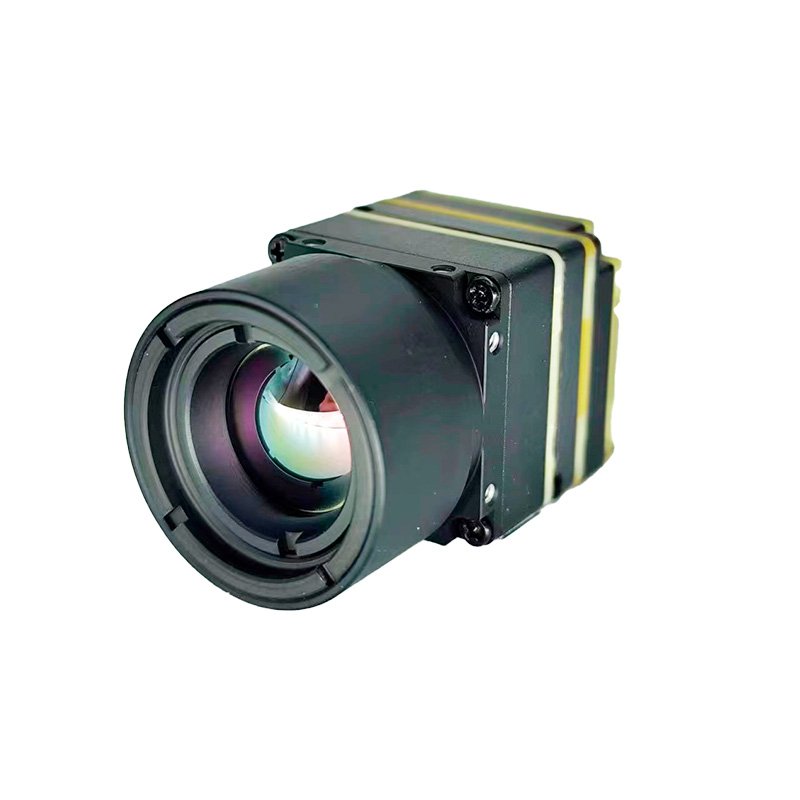
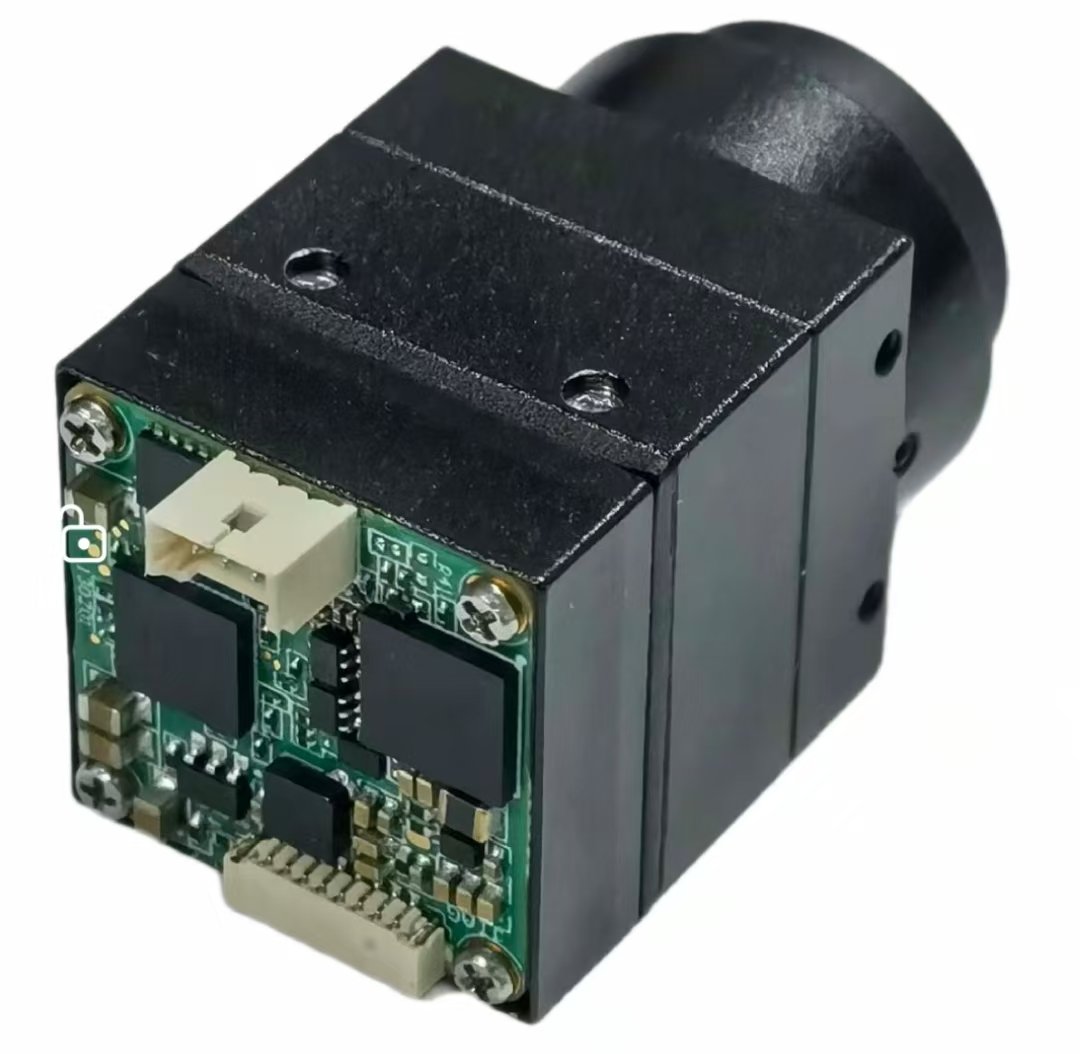
CBRITECH’s 640×512 thermal imaging camera core is designed around this type of integration. It combines a 640×512 infrared detector with a compact 20 × 20 mm module architecture and supports drone and thermal-monocular applications.
This guide explains the technical factors OEMs and system developers should consider when selecting thermal imaging hardware for drones and embedded vision systems.
What Is a Thermal Imaging Camera?
A thermal imaging camera creates an image from infrared energy rather than depending solely on visible light.
This difference is particularly important when the imaging objective involves detecting heat signatures or operating in conditions where ordinary cameras do not have enough visible illumination.
The core of the system is its infrared detector.
CBRITECH’s 640×512 module uses a vanadium oxide (VOx) uncooled infrared focal plane detector operating in the 8–14 μm band.
For an OEM, the thermal core can become the imaging component inside a larger finished product rather than being a complete standalone camera.
That makes the technology applicable to systems such as:
- thermal drones;
- FPV platforms;
- thermal monoculars;
- embedded infrared imaging equipment;
- remote observation systems;
- custom OEM thermal-imaging products.
The correct module depends on what the complete system needs to detect and how the thermal video will be processed or displayed.
Why 640×512 Resolution Matters
Resolution is one of the first specifications engineers encounter when comparing thermal cameras.
The target CBRITECH module provides a native thermal resolution of 640 × 512 pixels.
That means the detector contains substantially more thermal-image information than lower-resolution alternatives.
But resolution should not be considered in isolation.
For OEM development, a useful thermal imaging system depends on the relationship between:
resolution + detector sensitivity + lens + field of view + viewing distance + processing + output
A higher detector resolution can provide more spatial information, but the final performance still depends on the complete optical and electronic design.
This is why engineers should avoid choosing a thermal module purely because the number “640” looks better on a specification sheet.
The actual application needs to define the specification.
Understanding the 12 μm Pixel Pitch
The module uses a 12 μm pixel spacing.
Pixel pitch describes the distance between detector pixels.
For engineers, this specification becomes relevant when considering detector architecture, optics, module dimensions and the overall imaging system.
A thermal-camera design therefore needs to consider detector resolution and pixel pitch together rather than treating them as unrelated specifications.
When evaluating an OEM thermal module, ask how the detector architecture works with the selected lens and intended viewing distance.
That brings us to one of the most important parts of a thermal system: optics.
Lens Selection Can Change the Entire Thermal Imaging System
The same thermal core can behave very differently depending on the lens.
CBRITECH lists a particularly broad lens range for this module:
4 mm, 5.3 mm, 7 mm, 9.1 mm, 13 mm, 15 mm, 19 mm, 25 mm, 35 mm and 50 mm.
This gives OEM developers room to configure the imaging system around different application requirements.
A shorter focal length may be appropriate where a broader scene needs to be observed, while longer focal lengths can be relevant where a narrower view or greater observation distance is required.
That is particularly important when designing a thermal drone.
A drone used for broad observation does not necessarily need the same optical configuration as a platform intended to observe a smaller target from farther away.
Instead of asking:
“Which thermal camera has the best lens?”
OEM developers should ask:
“Which lens gives our detector the field of view and observation characteristics required by our application?”
That is a much more useful engineering question.
Why Thermal Drones Need Purpose-Built Camera Modules
Weight, dimensions, power consumption and video-interface compatibility become especially important when the camera is installed on an airborne platform.
A thermal drone cannot simply carry unlimited imaging hardware.
Every additional component affects the complete payload.
CBRITECH lists its 640 thermal core at 20 × 20 mm excluding the lens and ≤23 g excluding the lens, with rated power consumption of ≤0.8 W.
Those specifications make the physical integration discussion particularly relevant to drone developers.
A thermal-drone designer should evaluate at least four areas together:
Payload: Can the aircraft carry the camera, lens, mounting hardware and associated electronics without compromising the intended flight characteristics?
Power: Can the onboard electrical architecture supply the camera reliably?
Video transmission: Is the camera output compatible with the aircraft’s processing or transmission system?
Optics: Does the selected lens provide the required view from the expected operating altitude or distance?
Thermal-drone integration is therefore a system-engineering problem, not simply a camera-purchasing decision.
Where an FPV Drone Camera Module Fits In
FPV systems create another interesting camera requirement.
An FPV drone camera module needs to deliver usable video to the pilot or downstream video system with an architecture compatible with the platform.
CBRITECH’s thermal module supports CVBS output, and the product page also identifies USB support. Its listed analog format is PAL.
This makes interface selection an important part of the buying decision.
Not every FPV project requires thermal imaging.
CBRITECH also offers a dedicated FPV WDR Drone Night Vision Camera for visible-light/low-light FPV applications. That model uses a 1/2.8-inch image sensor, CVBS output and a stated minimum illumination of 0.0001 lux.
This distinction matters.
Thermal FPV vs Low-Light FPV
A thermal camera and a low-light camera solve different imaging problems.
A low-light FPV camera is designed to extract usable visible imagery where illumination is extremely limited.
A thermal camera detects infrared energy and represents differences in thermal radiation.
So an OEM should not automatically treat “night vision” and “thermal imaging” as interchangeable terms.
If the requirement is to retain a conventional visible scene under extremely low illumination, a specialized low-light FPV camera may be appropriate.
If the requirement is to visualize thermal differences, the thermal imaging core becomes the relevant architecture.
Why 50 FPS Is Important for Moving Platforms
The 640×512 thermal module specifies a 50 FPS frame rate.
Frame rate becomes particularly important when either the camera or the observed scene is moving.
That makes it relevant to drone applications.
An airborne camera may experience aircraft movement, turns, vibration and rapidly changing scene composition.
Higher temporal sampling can help provide smoother representation of motion than a much slower imaging system.
However, frame rate should again be considered alongside the rest of the video chain.
The detector may operate at 50 FPS, but the downstream electronics, video interface, transmission system, processing hardware and display architecture must also be designed appropriately.
Understanding NETD and Thermal Sensitivity
Another specification on the product page is NETD ≤40 mK.
NETD — Noise Equivalent Temperature Difference — is an important thermal-imaging specification because it relates to the detector’s ability to distinguish small thermal differences.
Generally, a lower NETD represents greater thermal sensitivity.
This becomes particularly valuable when an application needs to distinguish relatively subtle temperature differences rather than simply separating a very hot target from a cold background.
OEM buyers should therefore evaluate thermal sensitivity alongside resolution.
A 640×512 detector tells you how many thermal pixels are available.
NETD helps describe how sensitively the detector can distinguish thermal differences.
Those specifications answer different questions.
Four Thermal Display Modes
The module supports four listed color modes:
White Hot
Black Hot
Iron Red
Fusion
These palettes do not change the thermal radiation detected by the sensor. Instead, they change how the resulting thermal information is visually represented.
Different visualization modes can make particular temperature relationships easier for the operator to interpret.
For an OEM, the appropriate palette therefore depends partly on the user interface and intended task.
USB or CVBS: Which Interface Should You Choose?
Interface selection is another important engineering decision.
The CBRITECH product page identifies USB and CVBS output support, while its detailed specifications list CVBS/PAL and UART TX/RX connections.
CVBS can be useful in analog-video architectures and certain FPV systems where compatibility and straightforward video transmission are important.
USB can be attractive where thermal imagery needs to enter a computer or compatible embedded processing platform.
The correct choice depends on what happens to the image after the detector captures it.
For example, ask:
Does the image need to be displayed directly?
Does another processor need to analyze it?
Does the system need to transmit video wirelessly?
Is an existing analog FPV video architecture being used?
Will the thermal module connect to a computer?
These questions should be answered before selecting the final output configuration.
Developers working specifically with USB-based embedded imaging can also review CBRITECH’s broader USB camera module range, although conventional CMOS USB cameras and thermal infrared modules serve fundamentally different imaging purposes.
Power and Voltage Requirements for Embedded Integration
The module lists an operating voltage of 5V–16V and power consumption of ≤0.8 W.
These specifications matter for any embedded platform but become particularly important in battery-powered equipment.
In a drone, for example, the thermal camera shares available energy with motors, flight-control electronics, communication hardware, video transmission equipment and potentially other sensors.
An OEM therefore needs to evaluate the complete power budget rather than the camera alone.
A compact thermal module with relatively modest power requirements can make system integration easier, but proper power regulation and electrical design are still required.
Operating Temperature and Environmental Design
Thermal cameras are often deployed in environments very different from ordinary consumer electronics.
According to the product specifications, the 640×512 core has a listed operating-temperature range of −40°C to +80°C and storage range of −45°C to +85°C.
That broad operating specification can be relevant to outdoor and specialized equipment.
However, OEM designers still need to evaluate the complete assembly.
The detector specification alone does not establish the environmental rating of the finished drone, monocular or enclosure.
Thermal management, sealing, mechanical protection, connectors and the other electronics all affect final-product reliability.
Thermal Imaging for Monocular Systems
The product page also specifically identifies thermal monocular applications.
A monocular creates different engineering priorities from an FPV drone.
Weight remains important, but the designer may also need to consider display integration, battery life, ergonomics, optical configuration, controls and enclosure dimensions.
The thermal core is therefore only one component of the complete product.
For OEM development, the advantage of starting with a compact camera core is that the manufacturer can build the surrounding product architecture according to its own application rather than adapting a finished thermal camera.
Thermal Imaging Camera vs Conventional Night Vision Camera
These technologies are often grouped together, but they should not be treated as identical.
A conventional night-vision or ultra-low-light camera still works with visible or near-visible scene information depending on its architecture.
Thermal imaging works from infrared radiation associated with temperature.
This means each technology has its own strengths.
For an FPV project where the pilot needs familiar visual details and the environment still provides some usable illumination, CBRITECH’s 1500TVL ultra-low-light FPV camera may represent a more appropriate architecture.
For a system whose objective is thermal detection and infrared imaging, the 640×512 thermal imaging camera core is the relevant product.
What OEM Buyers Should Check Before Choosing a Thermal Camera Module
A thermal core should be selected from the requirements of the complete system.
Before moving toward a prototype, define the required thermal resolution, sensitivity, frame rate, field of view, observation distance, output interface, available voltage, power budget, physical space and payload restrictions.
Then consider the intended environment.
A camera designed into an FPV aircraft faces different mechanical and electrical requirements from one installed inside a handheld thermal monocular.
Lens selection should also happen relatively early in the design process because focal length influences what the camera can see and can affect the overall dimensions of the optical assembly.
For the CBRITECH 640×512 module, the availability of focal lengths from 4 mm through 50 mm provides multiple configuration possibilities rather than forcing every OEM application into a single optical arrangement.
Quick Specification Overview
| Specification | CBRITECH 640 Thermal Core |
|---|---|
| Thermal Resolution | 640 × 512 |
| Detector | VOx uncooled infrared focal plane |
| Frame Rate | 50 FPS |
| Pixel Pitch | 12 μm |
| NETD | ≤40 mK |
| Spectral Band | 8–14 μm |
| Output | USB / CVBS |
| Analog Format | PAL |
| Core Size | 20 × 20 mm, excluding lens |
| Weight | ≤23 g, excluding lens |
| Voltage | 5V–16V |
| Power | ≤0.8 W |
| Lens Options | 4–50 mm |
| Color Modes | White Hot, Black Hot, Iron Red, Fusion |
| Listed Applications | Drone and thermal monocular |
These specifications are taken from CBRITECH’s product page.
Choosing the Right Thermal Camera for Your Project
There is no universally “best” thermal imaging camera.
There is only a camera that is better matched to a particular system.
For drone and FPV developers, physical size, payload weight, frame rate, power and video interface can be critical.
For thermal monocular developers, detector resolution, thermal sensitivity, lens selection, battery consumption and mechanical integration may carry greater weight.
For embedded vision developers, the output architecture and ability to integrate the camera with downstream electronics can become the deciding factor.
The CBRITECH 640×512 Infrared CVBS/USB Thermal Imaging Camera Core combines a 640×512 VOx detector, 50 FPS imaging, 12 μm pixel pitch, ≤40 mK NETD, compact module dimensions and a wide selection of lenses for OEM thermal imaging development.
The key is to start with the application requirements and then configure the detector, optics, output and supporting electronics around them.
Frequently Asked Questions
What is a thermal imaging camera?
A thermal imaging camera detects infrared radiation rather than relying only on visible illumination. It converts differences in detected thermal radiation into an image that can be interpreted by the user or downstream system.
Is a thermal camera suitable for a drone?
Yes. Thermal modules can be integrated into drone systems, but developers need to consider weight, dimensions, power, output interface, lens selection and the aircraft’s overall payload architecture. CBRITECH specifically lists drone use for its 640×512 thermal core.
What resolution does the CBRITECH thermal module provide?
The module provides 640 × 512 thermal resolution with a 12 μm pixel pitch.
Can the thermal camera core be used as an FPV drone camera module?
The product is specifically described for drone use and supports CVBS output, which can be relevant to FPV video architectures. Compatibility with a particular aircraft or transmission system should be confirmed during integration.
What is the difference between an FPV night-vision camera and a thermal camera?
An ultra-low-light FPV camera captures conventional scene imagery under very low illumination, while a thermal camera detects infrared radiation associated with temperature differences. The correct technology depends on what the system needs to observe.
Does this thermal camera support USB?
The product page identifies both USB and CVBS output support. Its detailed specification also lists CVBS/PAL and UART TX/RX connections. The exact configuration required for an OEM project should therefore be confirmed before ordering.
What lens options are available?
CBRITECH lists 4 mm, 5.3 mm, 7 mm, 9.1 mm, 13 mm, 15 mm, 19 mm, 25 mm, 35 mm and 50 mm options for this thermal camera core.
Is this a finished thermal camera?
The page describes it as a thermal imaging camera core/module, meaning it is particularly relevant to integration into a larger drone, monocular or OEM imaging system rather than being treated simply as a finished consumer camera.